


Acute and Chronic Sinusitis - Regulation Medicine Neural Therapy Treatment Approach The sinuses are…

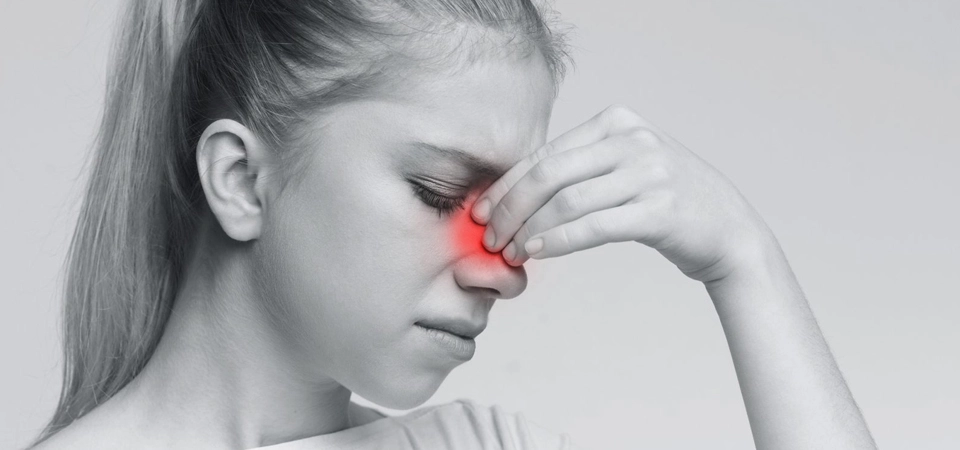
During nasal breathing, particularly during the exhalation phase, air enters the sinuses. They are responsible for adjusting the tone of the human voice and reducing the weight of the head. As long as air continues to move in and out of the sinuses, they show no functional disturbance. However, the moment airflow into one or more of the sinuses is disrupted for any reason, the condition known as sinusitis emerges.
The leading causes of disrupted connections between the sinuses and the nose are prolonged, poorly treated colds and various allergic events. Both of these conditions cause sinusitis by blocking the airways with the swelling (edema) they create in the mucosa, allowing bacteria to proliferate. Deviated septum and turbinate thickening can also be common causes of sinusitis.
Catarrhal (cold-like) or suppurative (inflamed) infection of the sinuses may affect one or several sinuses. The condition that results when all the sinuses become involved in the infection is called pansinusitis. All of these are rhinogenic (nose-originated) sinusitis cases. There is also a rarer form, maxillary sinusitis, which originates from the teeth – tooth extraction, faulty implants, inflammation...
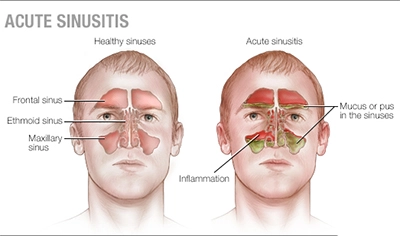 The symptoms of acute sinusitis include nasal discharge together with nasal congestion, temporary hearing loss, and pharyngitis and laryngitis resulting from postnasal drip. Fever is rarely seen in sinusitis. Headache is seen particularly during the period when the sinuses are blocked. Headache is more often a finding associated with chronic sinusitis.
Treatment:
From the perspective of complementary medicine, sinusitis is fundamentally rooted in interference fields and dysfunction in the intestines. For this reason, locally applied therapies often fail to produce the correct response. From this perspective, regulating the gut flora should be the first approach.
History and findings, a comprehensive physical exam, and then a comprehensive and detailed history once again. During the physical exam, it is strongly recommended to examine Adler points from the standpoint of interference fields.
Local treatment should be applied to the local tender points where problems have been identified. Segmental treatment – in short, treatment should be examined and applied with consideration of which segment is involved.
Nutrition and bowel habits should be thoroughly questioned. The temporal relationship should be taken into account in the history. Sinusitis that arises as a result of another condition, whether acute or chronic, is often rooted in interference fields. We often observe that the interference field in question is dysfunction in the intestines.
Local therapy: The trigeminal nerve exit points, and the mastoid and tonsils should be stimulated to facilitate lymphatic flow. The T8-L1 and S2-S4 segments, which are important for the intestines, should be stimulated. When deemed necessary, the ganglion pterygopalatinum,
stellate ganglion and celiac ganglion should be infiltrated with deep injections.
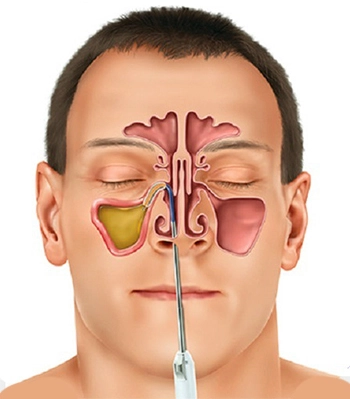 Treatment of Interference Fields and Stimulation Therapy
For sinusitis located in the frontal region, an injection should be given at the foramen supraorbitale. For maxillary sinusitis, the foramen infraorbitale should certainly be stimulated.
Other Supportive Treatments
- Injection of interference fields with a local anesthetic (Procaine, Lidocaine): the sinuses, all scar tissue, the roots of the teeth, and the tonsils (tonsilla pharyngea and tonsilla palatina)
- Local anesthetic injection to the local region: cervical paravertebral muscles, nerve exit points (N. supraorbitalis, greater and lesser occipital nerves, N. infraorbitalis, N. mentalis), the temporomandibular joint, N. nasolabialis, and injection of the stellate ganglion and pterygopalatine ganglion
Sources Consulted:
• Nazlikul, H: Neural Therapy Textbook
• Nazlikul, H: Another Treatment Is Possible: Neural Therapy
• H. Barop's Atlas of Neural Therapy (Translator: H. Nazlikul)
• L. Fischer's Neural Therapy Book (Translators: H. Nazlikul and Y. Tamam)
• James W. McNabb, Joint and Soft Tissue Injections (Translators: H. Nazlikul and Y. Tamam)
• Weinschenk, S: Neuraltherapie
• Fischer, L et al: Lehrbuch Integrative Schmerztherapie