


Dizziness is not destiny — it can be treated! Balance is the mechanism that orients us in…


Balance is the mechanism that orients us in three-dimensional space and adjusts our body posture accordingly, so as to prevent falling. In a person experiencing dizziness, there is a perceived, false sense of movement between the person and the environment. Information about our orientation in space is transferred through deep sensation (the proprioceptive system), the eyes, the eye muscles, and the vestibular system. Once the incoming information is processed by the central nervous system, extension or flexion of the relevant muscle groups occurs.
Vertigo, a hallucination of movement, is a symptom of disorders arising in the vestibular system.
Dizziness can have both physical and psychological causes.
It usually results from conflicting information coming from the sensory organs responsible for our sense of balance — namely the eyes, ears, and muscles.
Dizziness can have various causes, or it may be a symptom of other diseases. Among the most common causes or triggers of dizziness are driving a car or a boat, blood pressure that is too low or too high, irregularities in the cervical vertebrae, vascular calcification, or inner ear diseases.
Dizziness may be accompanied by a feeling of fullness and ringing in the ear. It can also cause nausea and vomiting.
Some people describe balance problems as dizziness. This type of balance disorder, in which the environment does not actually spin, sometimes arises from a problem related to the inner ear.
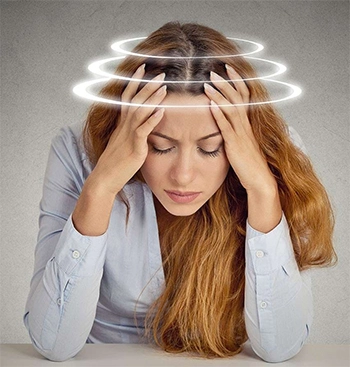 VERTIGO: Patients describe their difficulty maintaining balance with the word vertigo. This word comes from the Latin verb meaning "to turn." These patients frequently say that they themselves, or their surroundings, are spinning. Vertigo most often originates from an inner ear problem.
WHAT ARE MOTION SICKNESS AND SEASICKNESS?
Some people feel nauseated, and sometimes even vomit, when boarding a plane or riding in a car. This is called motion sickness. Many people experience this discomfort when boarding a ship, so — even though it is the same phenomenon — it is called seasickness.
Seasickness is a mild discomfort. It is not an indication of any medical disorder. However, these complaints can sometimes greatly restrict a person's travel and, in turn, their quality of life. In very few people, these complaints can persist for several days even after the journey has ended.
WHERE AND HOW DOES DIZZINESS DEVELOP?
Our sense of balance is located in the ear. The ear is a sensory organ responsible for controlling both hearing and balance. This is why hearing and balance problems often occur together.
The balance organ is part of the inner ear and is also known as the vestibular organ.
The vestibular apparatus in the inner ear — its three semicircular canals, together with the two endolymph-filled macular organs, the saccule and the utricle — is responsible for registering rotational movements in space.
For this reason, dizziness can originate directly from the ear. It can arise from stimuli, diseases, or inflammation in the inner ear, the labyrinth, or the vestibular nerve. Inflammation of the vestibular nerve is called vestibular neuritis.
Acoustic neuroma is a benign tumor of the vestibular nerve.
Vertigo can also result from how stimuli are processed in the central nervous system. This also applies, for example, to pressure changes during diving or high-altitude training.
There is also a condition known as psychogenic dizziness, which usually occurs as a result of stress or psychological strain. Social phobias, panic attacks, and other psychosomatic disorders can also present with symptoms of dizziness.
There are also types of vertigo that are not ear-related and have an organic cause. For example, fever and severe viral infections can be accompanied by dizziness. People with neurological diseases such as migraine, epilepsy, Alzheimer's, dementia, and multiple sclerosis may also suffer from dizziness. Deficiencies of oxygen, vitamin B12, energy, sugar (hypoglycemia), and certain nutrients can also be responsible for vertigo. Fasting or malnutrition can likewise cause this condition, as can systemic metabolic diseases such as diabetes mellitus. However, in my personal experience, cervicogenic dizziness originating from the neck is more common. Its root cause lies in the cervical spine. Finally, cardiovascular diseases can also cause vertigo.
WHAT IS MENIÈRE'S DISEASE?
Prosper Menière was a French physician. He described this inner ear disease in 1861. A typical example of a Menière's attack is the sudden onset of dizziness, ringing in the ear, and hearing loss, accompanied by a sensation of pressure in one ear. As the disease progresses, the other ear may also be affected.
An important part of treatment for Menière's disease consists of prophylaxis and, accordingly, reducing the frequency of attacks. However, there is no definitively effective treatment. ENT physicians recommend various medications as well as a low-salt diet and diuretic measures.
THE ANATOMY OF BALANCE
Vertigo, seasickness, and motion sickness are related to the balance system. Space researchers refer to this sensation as spatial orientation. The balance system is located in the inner ear and tells the brain where the body is in space, the direction it is facing, which direction it is moving in, and whether it is in motion or at rest.
A diagnosis must always be made before starting treatment. This includes a detailed ear, nose, and throat examination, along with certain necessary laboratory, endoscopic, and X-ray studies. Bacterial infections are treated with antibiotics, but these provide only temporary improvement. In chronic sinusitis, surgical intervention is needed to drain the blocked sinuses.
The sense of balance is provided by complex relationships among the following parts of the nervous system.
- The inner ear (labyrinth) determines the direction of movement.
- The eyes determine the body's position in space (upside down, etc.) and the direction of movement.
- Pressure receptors in the joints and spine determine which part of the body is lower and which part is touching the ground.
- Sensory receptors in the muscles and joints determine which part of the body is moving.
- The central nervous system (the brain and spinal cord) processes signals from the previous four systems, resulting in a coordinated perception.
The symptoms of motion sickness and dizziness arise when the central nervous system receives conflicting messages from these four systems.
For example, imagine boarding a plane on a stormy day, and the plane is shaking due to air currents. But your eyes do not perceive this motion, because all you can see is the inside of the plane. As a result, your brain receives messages that do not match one another. This is why you may experience airsickness.
Imagine sitting in the back seat of a car reading a book. Your inner ear and skin receptors will perceive the motion of the journey, but your eyes will only see the book. This is why you may feel motion sickness.
To give a real medical example, imagine that a blow has damaged only the inner ear on one side. The damaged inner ear does not send the same signals as the normal inner ear. This gives the brain incorrect information about rotational movement, and the person may complain of vertigo or a spinning sensation. Nausea sometimes accompanies this as well.
YOU CAN CLASSIFY VERTIGO ACCORDING TO ITS TRIGGERING CAUSE:
- Motion sickness or positional vertigo is triggered by certain head movements or reaching.
- Orthostatic dizziness results from standing up quickly.
- Dizziness is a symptom of motion sickness.
ACCORDING TO THE REGULATION MEDICINE / NEURAL THERAPY APPROACH, WHICH MEDICAL EVENTS CAUSE DIZZINESS?
1. Circulation: Circulatory disorders are among the most common causes of dizziness. If the brain is not adequately supplied with blood, you begin to feel dizzy. Almost everyone has felt this a few times when suddenly standing up after lying down. However, some people complain of dizziness due to chronic causes. This is usually due to arteriosclerosis. This condition is most often seen in people with high blood pressure, diabetics, and those with high blood lipids. It is sometimes also seen in people with insufficient heart function or those complaining of anemia. Certain substances, especially nicotine and caffeine, reduce blood flow to the brain. Excessive salt in the diet also reduces blood flow. Sometimes there may be circulatory disturbances related to stress, agitation, or tension. If the inner ear does not receive enough blood, a more specific type of dizziness called vertigo occurs. The inner ear is very sensitive to changes in blood circulation, so everything mentioned above regarding poor circulation to the brain also applies to the inner ear.
2. Injury: A skull fracture that also damages the inner ear leads to vertigo accompanied by nausea and hearing loss. Dizziness lasts for several weeks. During this time, the unaffected side gradually takes over the functions.
3. Infection: Viruses (for example, those causing the common cold) can affect the inner ear and its nerve connections to the brain. This causes severe vertigo, while hearing is usually unaffected. However, in infections caused by bacteria, both balance and hearing functions are impaired.
4. Allergy: Some people may experience dizziness or vertigo when they consume foods they are allergic to or encounter particles in the air.
5. Neurological diseases: Diseases affecting the nervous system, such as multiple sclerosis, syphilis, and tumors, cause impaired balance.
TIPS FOR PROTECTING AGAINST MOTION SICKNESS
1. Always sit in a place where your body's movement can be perceived in the same way by both your inner ear and your eyes. For example, you can sit in the front of the car and look at distant scenery, go up on deck on a ship and watch the horizon, or sit by the window on a plane and watch outside.
2. If you get carsick, you should not read a book or sit in seats facing against the direction of travel.
3. You should not talk to or watch another passenger who has motion sickness.
4. Right before or during travel, avoid strong smells and spicy or oily foods.
5. Take any medication recommended by your doctor before the journey.
The vast majority of dizziness and motion sickness cases are mild, and people can treat themselves. However, it is important for people with severe or worsening symptoms to see an ENT specialist. The ENT specialist will examine whether the issue originates from the ear. Neural therapy is very beneficial for dizziness and vertigo that is not ear-related.
MEASURES THAT CAN BE TAKEN TO REDUCE DIZZINESS
- Avoid sudden changes in position. For example, do not suddenly stand up from a lying position or turn abruptly from one side to the other.
- Avoid excessive head movements (especially looking up) or rapid head movements.
- Reduce the use of substances that disrupt circulation (nicotine, caffeine, and salt).
- Stay away from stress that causes dizziness or from foods you are allergic to.
- When experiencing dizziness, avoid driving, operating dangerous equipment, or engaging in potentially harmful activities such as climbing stairs.
Other recommendations to keep in mind:
- Be sure to get enough sleep
- Eat a regular, healthy diet
- Exercise in fresh air
- Drink enough water for good circulation
- Do relaxation exercises and manage stress
- Stay away from stress so your neck muscles can relax
Neural Therapy for Dizziness (Vertigo):
A detailed history should be taken and a comprehensive physical examination performed. The temporal relationship of any hearing loss should be carefully assessed. Reflex zones should be examined. When infection is suspected, the immune system and the body's acid-base balance should be thoroughly evaluated.
In the neural therapy approach, treatment is directed at the underlying cause. If the problem is circulatory in origin, circulation is regulated. If the problem originates from the neck, treatment is shaped according to an assessment of all the muscles located there as well as the facet joints. If the source of the problem is the jaw joint or the upper cervical region, if there is a disturbance in nerve conduction, or if the vertigo is due to a hormonal disorder or stress, treatment is planned accordingly.
Neural therapy applications are individualized for each patient, which is why they produce such gratifying results.
The jaw joint and its surrounding area are another important region that must be examined. During the physical examination, Adler's points should be assessed for interference fields. Examining Adler's points is important both for identifying interference fields and for evaluating whether there is an acute or chronic problem in the ear.
SOURCES CONSULTED
- Nazlikul, H: Neural Therapy Textbook
- Nazlikul, H: Neural Therapy — Another Treatment Is Possible
- H. Barop's Neural Therapy Atlas (Translator: H. Nazlikul)
- L. Fischer's Neural Therapy Book (Translators: H. Nazlikul and Y. Tamam)
- James W. McNabb, Joint and Soft Tissue Injections (Translators: H. Nazlikul and Y. Tamam)
- Weinschenk, S: Neuraltherapie
- Fischer, L et al: Lehrbuch Integrative Schmerztherapie
- Nazlikul, H: Dissertation (Doktor medicinae) im Rahmen des postgradualen Universitätslehrganges für Ganzheitsmedizin – Regulationsmedizin "Neuraltherapie Naturheilverfahren, Regulationsverfahren und Herdgeschehen" von PD. Dr. med. Hüseyin Nazlikul 2010 Die Medizinische Fakultät Charité.
- Nazlikul, H.: Thorakale Wirbelblockaden erfolgreich therapieren S34-38, 1, 2/2008 für Allgemeinärzte
- in Abstractband Deutscher Schmerztag 1998
- Nazlikul H, Babacan A. Neural therapy and its role in injections. Babacan A, editor. Pain and Injections. 1st Edition. Ankara: Türkiye Klinikleri; 2019. p.110-7.
- Reuter URM, Oettmeier R and Nazlikul H (2017) Procaine and Procaine-Base-Infusion: A Review of the Safety and Fields of Application after Twenty Years of Use.
- Herget, F, H, Nazlikul, H: „Neurophysiologie und Neuropharmakologie der Schmerzmatrix" S. 56 ff
- J. Cassuto et al.; Antiinflammatory properties of local anesthetics and their present and potential clinical implications; Acta Anaesth Scand 2006; 50:265-82
- M.W. Hollmann et al; Local Anesthetic effects on priming and activation of human neutrophils; Anesthesiology 2001:95:113-22
- Barop, H.: Lehrbuch Neuraltherapie, Haug Verlag 1996