


Neck Pain - Neural Therapy in Cervical Disc Herniation - One of the symptoms of a herniated disc in…

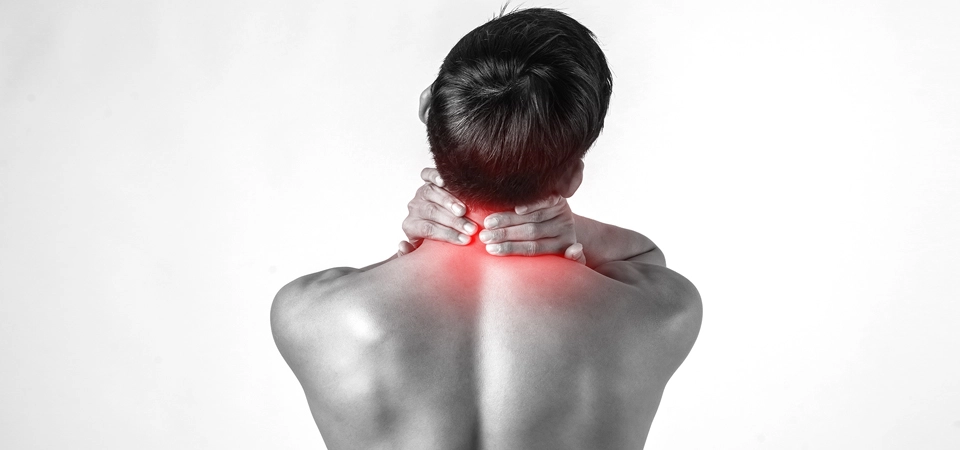
One of the symptoms of a herniated disc in the cervical spine is severe neck pain.
Severe pain in the neck area that extends to the head and arms can stem from a herniated cervical disc. Among the most common causes of a herniated neck disc are heavy loads lifted or carried without precaution and injuries (for example, from rear-end collisions).
HERNIATED DISC IN THE CERVICAL SPINE
10% of all herniated discs occur in the cervical spine. Most herniation in the neck vertebrae occurs between C5-C6 or C6-C7.
The intervertebral disc consists of a gelatinous core on the inside and an outer covering. If this shell tears, the gelatinous core leaks out. This leaked core presses on the spinal cord, causing severe pain.
The risk of a herniated neck disc increases with age!
Older individuals are more affected by cervical disc herniation. This is because the intervertebral discs lose their elasticity with age. Another reason is an increase in the laxity of the vertebral joints. This increase causes greater wear on the intervertebral discs.
However, young people can also be affected by this type of injury. Sudden bending of the neck can cause injury to the cervical spine. Poor posture and excessive strain can also result in a herniated disc.
SYMPTOMS OF A HERNIATED DISC IN THE CERVICAL SPINE
-
Neck pain
-
Shoulder pain
-
Back pain
-
Headache; especially tension-type headache
-
Sensory disturbances
-
Dizziness
-
Visual disturbances
-
Ringing in the ears (tinnitus)
-
Numbness in the arm, hand, and fingers
TREATMENT OF A HERNIATED DISC IN THE CERVICAL SPINE
If there is an acute (newly developed) herniated disc in the cervical spine, conservative treatment is usually chosen first. Surgery is not usually needed. Conservative treatment uses anti-inflammatory drugs, painkillers, and muscle relaxants. A neck brace is often recommended to support the cervical spine.
Other treatment options include physiotherapy applications and relaxation exercises prescribed specifically for the individual.
For a herniated neck disc that does not require surgery, the combination of the Holistic Regulation Medicine approach, Neural Therapy, and Complementary Medicine is more effective!
Because most patients do not benefit from conventional treatments, they seek out different options. Neural therapy, manual medicine, manual therapy, chiropractic interventions, osteopathy, and acupuncture are the main methods sought. Phytotherapy and homeopathy are also gaining interest, as they support the body's healing process.
Remember that 98% of herniated neck discs or neck pain stem from functional problems. For neck pain and herniation of functional origin, the combination of Neural Therapy and Manual Medicine is quite successful.
For long-standing symptoms, correctly training the neck muscles is recommended. Consult your doctor about which options are suitable for your condition, or reach a qualified Neural Therapist through www.noralterapi.com, or a fully trained Manual Medicine Specialist through www.manueltip.org.
Surgical procedure
At most 2% of neck-related problems present with radicular symptoms, meaning that a nerve root is being compressed. Of these radicular neck-related pains, at most 10-15% require surgical intervention.
THE MOST EFFECTIVE TREATMENT FOR A HERNIATED NECK DISC IS THE NEURAL THERAPY APPROACH!
Neural therapy is a treatment method based on autonomic nervous system dysfunctions, applied to specific areas using defined techniques with 1-0.5% procaine or 0.5% lidocaine.
Neural therapy is an approach that is one step ahead of conventional methods, as it offers the opportunity to intervene in the pathological process at the dysfunction stage, before a disease pattern forms.
The resulting pathological condition is understood not as merely a localized symptom, but as a reflection of a blockage in the system. Intervening at the system level is just as important as intervening at the localized area or point.
Neural therapy is the most effective of the regulation treatments. In neural therapy, the temporal connection of illnesses is very important. How and after which event the illness appeared is very important for diagnosis.
In Turkey, this form of treatment became known through the training I have given under the Scientific Neural Therapy Association, which I founded in 2004. Since 2008, it has become a treatment method that has attracted growing interest in Turkey with each passing year, and one in which many physicians have been trained.
Neural therapy works through two basic mechanisms. The first of these is the segmental mechanism. This is based on the local anesthetic injection made into the segment where the illness extends and that segment's connection with the spinal cord. The second is an interference field that may not appear directly related to the illness and is sometimes located far from the problem area. In particular, a good Neural Therapy Specialist can identify the interference fields that may be causing the problem and eliminate it by applying local anesthetic to those areas.
Complaints in the neck do not necessarily have to originate in the neck. This problem can originate from a tooth, the tonsils, the diaphragm, muscles, or other areas.
Local irritations (chemical, physical, or traumatic) anywhere in the body, whether previously experienced or still present, can turn into a pathological area — in other words, an interference field — and can disrupt communication in the neurovegetative system, negatively affecting other bodily functions as well.
Neural Therapy applied to this area with local anesthetic can correct this dysfunction, and as a result, a sudden drop in symptoms can be observed.
Interference fields are most often found in the head region, particularly in the teeth, tonsils, and paranasal sinuses.
 THE NEURAL THERAPY PROTOCOL FOR NECK-RELATED PROBLEMS AND HERNIATED NECK DISC
Comprehensive History and Examination: The medical history taken from a patient in neural therapy differs in some respects. In addition to the general history, it is necessary to take a special history from the person using the neural therapy approach. Because it is very important to establish the temporal relationship between the onset of the illness and events that coincide with it in time.
Surgical interventions: Changes that appear in the patient after surgery or dental treatment and their connection to the patient's complaints are investigated.
Trauma: A history of local or widespread trauma prior to the onset of complaints is investigated.
Past illnesses: Past illnesses, medications used, and possible medication misuse are investigated.
Emotional intensities and traumas: The connection of complaints to a lived emotional trauma; the presence of stress, grief, sorrow, distress, and anger are investigated.
THE CORRECT TREATMENT OF MYOFASCIAL TRIGGER POINTS IS VERY IMPORTANT IN THE TREATMENT OF HERNIATED NECK DISCS
The difficulty in trigger point treatment stems from the fact that the pain is not always located at the site of the trigger point. According to the conventional pain treatment approach, treatment is usually applied to the area where the pain is located, but trigger points cause referred pain. For this reason, it is necessary to know the areas where trigger points form for each muscle. I have been giving training in Turkey on effective neural therapy applications for trigger point areas since 2008. To date, I have trained around 200 physicians on this subject. Treatment performed without finding the actual trigger point is ineffective or only temporary.
It must not be forgotten that in the treatment of Active Myofascial Trigger Points, it is not the location of the pain but the trigger point itself that must be treated!
Disruption of muscle metabolism due to chemical and hormonal causes leads to resistance in trigger point treatment. In addition, nicotine, caffeine, and alcohol consumption also reduce treatment success.
In the neural therapy approach, after the patient's history has been carefully taken, when approaching painful conditions, not only the area where the pain is felt but also its origin must be investigated.
Sources Used:
• Nazlikul, H: Neural Therapy Textbook
• Nazlikul, H: Neural Therapy - Another Treatment Is Possible
• H. Barop's (Translator H. Nazlikul) Atlas of Neural Therapy
• L. Fischer's (Translator H. Nazlikul and Y. Tamam) Neural Therapy Book
• James W. McNabb (Translator H. Nazlikul and Y. Tamam) Joint and Soft Tissue Injections
• Weinschenk, S: Neuraltherapie
• Fischer, L et al: Lehrbuch Integrative Schmerztherapie