


Understanding Friedrich Nietzsche and Making Sense of Him Friedrich Nietzsche is a thinker who left…

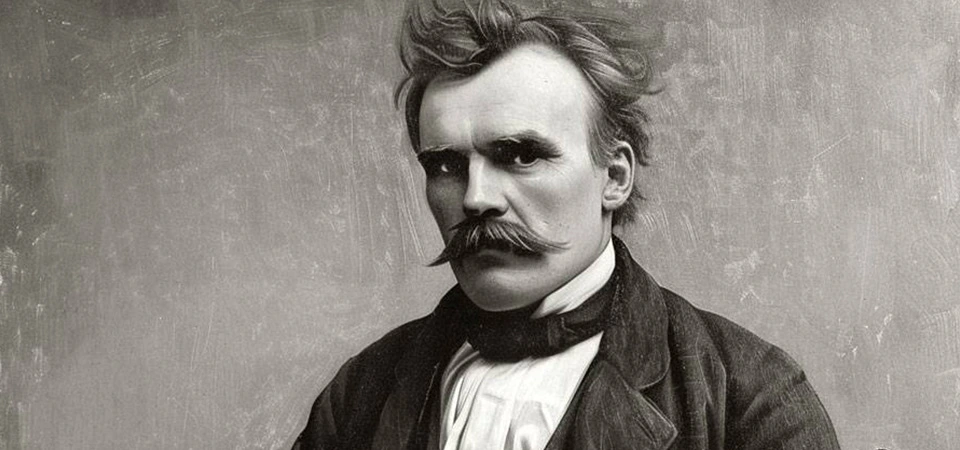
Understanding him and making sense of him is not limited to reading his works alone; it also requires a careful approach to his life, the spirit of his era, and the layered structure of his philosophy.
Nietzsche's Life and Contradictions
It is not possible to fully grasp Nietzsche's philosophy without understanding his life. Born in 1844 in a small town in Germany, Nietzsche grew up as the child of a clergyman's family. However, in later years, he distanced himself from religious values and developed a system of thought that criticized traditional moral systems. This is one of the most fundamental contradictions of his life: on one hand, the Christianity in which he was rooted, and on the other, his effort to free himself from those roots.
Health problems also occupied an important place in Nietzsche's life. Struggling with severe migraines and eye problems in his 30s, the thinker clearly conveys in his works how deeply these physical trials left their mark on his world of thought. When he said, "Pain leads a person either to ruin or to strength," he was questioning humanity's tragedy and resilience based on his own experiences.
Nietzsche's World of Thought
Nietzsche's philosophy centers on the destruction of traditional values and the reconstruction of the individual. His concept of the "Übermensch" (overman/superman) expresses that humans should surpass their existing limits and create their own values. However, this concept has often been misunderstood. Nietzsche does not impose an ideal; instead, he argues that the individual must realize their own inner potential.
The phrase "God is dead," which frequently appears in his works, expresses the spiritual void of the modern world and the collapse of traditional values. Here, Nietzsche offers a critique of nihilism. According to him, the collapse of old values offers the individual an opportunity to create new values. However, this process is never easy and carries a great responsibility for the individual.
Making Sense of Nietzsche Through His Works
The best way to understand Nietzsche is to dive deeply into his works. Here are some of his key works and the meanings that can be drawn from them:
1. "Thus Spoke Zarathustra" (Also Sprach Zarathustra):
This work is Nietzsche's masterpiece, in which he presents his philosophy through a literary narrative. Zarathustra, as the mouthpiece of Nietzsche's philosophy, represents humanity's effort to surpass its limits and its search for new meaning. The concept of the Übermensch is at the center of this work.
2. "On the Genealogy of Morality" (Zur Genealogie der Moral):
Nietzsche questions the origins of morality and claims that modern morality is shaped by power relations. This work is particularly notable for its criticisms of traditional Christian morality.
3. "Ecce Homo" (Behold the Man):
"Ecce Homo," an autobiographical work by Nietzsche, presents an evaluation of his own philosophy. It serves as a guide to understanding both the man himself and his philosophy.
4. "Beyond Good and Evil" (Jenseits von Gut und Böse):
Here, Nietzsche emphasizes that humans must go beyond morality and approach life in a more original and creative way. In this work, the emphasis placed on humanity's inner strength and will is notable.
Nietzsche's Lasting Contradictions
Nietzsche argues that humans are both a tragedy and a potential. This contradiction forms the foundation of his philosophy. While he wanted, on one hand, to liberate people from existing values, he also acknowledged, on the other, that this liberation is a heavy burden. Nietzsche's life and philosophy, full of contradictions, have added depth to his works and forced his readers to think.
Conclusion: Understanding Nietzsche and Making Sense of Him
Understanding Nietzsche begins with accepting his contradictions and the multilayered nature of his works. Nietzsche was not only a philosopher, but also a psychologist of the soul who tried to explore the limits and potential of humanity. His philosophy is a call inviting the individual to create their own values and to make sense of their own life.
When thinking and writing about Nietzsche, it can be meaningful to remember these words:
"He who has a why to live can bear almost any how."
This is one of the most beautiful expressions summarizing the bond between Nietzsche's life and philosophy.
Dr. Hüseyin Nazlikul