

Acceptance and Forgiveness Are Vitally Important! The Ho'oponopono philosophy centers first and…
Forgiveness is an important sign of strength and love. Because of the culture we were raised in, we often struggle to forgive.
According to ancient, deeply rooted wisdom carried within a traditional Hawaiian approach, forgiving the person we are dealing with is believed to lighten a burden — the burden of guilt. This belief is based on the philosophy that "we must forgive ourselves and let go of the pain within us." But forgiving, and being forgiven in turn, means far more than that.
 To forgive means to accept. The thing people struggle with most stems from their failure to accept the situation they're in. It's impossible to find a solution without naming the problem and accepting it. For this reason, acceptance must come first. And the first condition of acceptance is forgiveness.
Time flows by quickly. It's not possible for us to take back a single frame of what we experienced or did yesterday. Since we can't turn back time, is there any point in getting stuck on those moments and poisoning our lives with them?
Picture a computer. Imagine every file on that computer open at once on the desktop! How efficiently could the computer really run? Likewise, for us to leave old files open, to keep dwelling on them, and to keep blaming ourselves or others, will not be a solution. On the contrary, it will exhaust us, rob us of sleep, scatter our attention, and reduce our productivity. The first, indispensable step to reversing this is closing those files. In other words, it requires us to forgive — to release the ties binding us to the past, to forgive, and to let go.
Ho'oponopono, ancient Hawaiian wisdom, is a powerful ritual of forgiveness; it carries within it an approach that frees us from the vicious cycle that steals our energy and our joy for life, constantly makes us feel guilty, and pushes us to look for someone to blame.
The Ho'oponopono ritual reminds us to love, unconditionally, all of humanity, nature, and the universe — beginning with ourselves — and that we are connected to it. It shows us that whatever prejudices we hold, we are not part of this vibration in the universe.
While holding negative thoughts, we may not be able to feel the vibrations radiating from the universe in a positive direction. But when we forgive and let go, there is an opportunity for closed doors to open once again.
The good news is that no preparation is required to forgive or to let go — it can be done at any time. To forgive, all that's needed is to listen, wholeheartedly, to the voice of the child within us, and to focus on that pure love coming from our heart.
So what does this ancient wisdom teach us?
It's impossible to find a solution without acceptance. There's something I learned years ago from my late mentor, Prof. Dr. Horst Ferdinand Herget: "Accepting the illness is 50% of the cure," he used to say. This holds true for overcoming all diseases and achieving health as well. I see that my mentor's approach draws from the same source as this ancient wisdom. Love is universal, and unconditional love is the greatest force there is. To accept is also to forgive — and, at the same time, to release and let things flow.
THE HO'OPONOPONO HAWAIIAN FORGIVENESS RITUAL
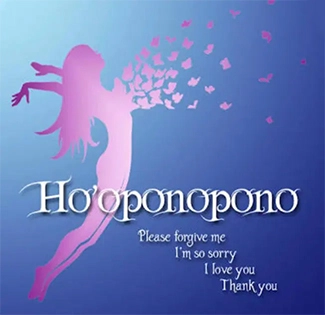 When we examine the ancient wisdom of the Ho'oponopono Hawaiian ritual, we see that its sages always knew the great healing power of forgiveness and letting go. They have applied this for years, both as individuals and as families, communities, and societies. Although it has only become known in the West over the last 20 years, its understanding in Turkey is even more recent. Despite a few translated books, this ancient wisdom still remains limited.
The Ho'oponopono forgiveness ritual has been part of Hawaiian culture for centuries. Translated, it means "to correct something" or "to set something right." In fact, it is the spiritual dimension of what we refer to in the regulation medicine approach as reorganizing and regulating the vegetative, or autonomic, nervous system.
This ancient Hawaiian approach, Ho'oponopono, teaches us to take responsibility for ourselves, our emotions, and our actions. In other words, it teaches us that we must own up to our part and stop blaming others.
The moment you accept the problem, the constant feeling of guilt we carry begins to be replaced by solutions and love. Love is the greatest force for all living beings. Once we accept and begin, a great energy we were never previously aware of is released. This released energy is described as "the driving force of Ohana." Ohana, which encompasses all living beings on earth, includes our family and ancestors, all people and animals, nature — in short, the entire world...
According to the Ho'oponopono ritual, it is believed that there is a deep and inseparable bond between all living things on earth. According to this belief, healing is thought to begin with love. It assumes that the more at peace we are with ourselves and our surroundings, and the simpler we make our connections, the stronger we will feel our bond with the universe.
WHAT ARE THE EFFECTS OF THE FORGIVENESS AND RELEASE RITUAL?
The Ho'oponopono forgiveness ritual is based on the idea of resonance: we unknowingly affect everyone we see, feel, and perceive. Nothing happens without a person's reaction. In short, this ritual assumes that we are in vibration with the entire universe.
The Ho'oponopono Ritual:
- Heals ourselves first, and consequently our surroundings.
- Resolves painful, exhausting thoughts, the flawed patterns that make us ill, and problems in relationships.
- Shows how important it is to accept what is.
- Teaches that acceptance is the first important step in solving problems.
- Teaches optimism.
- Teaches that happiness, health, and peace are the right of every living being.
The forgiveness ritual consists of five very simple sentences. Hawaiians perform this ritual not only for themselves, but also for family members, loved ones, animals, ancestors, and nature.
It means nourishing first your inner world, then your surroundings, and finally the entire universe with love.
When we trace this ancient wisdom back to its source, it means that, within Ohana, we are actually connected to everything around us and are in vibration with it. We know that what we perceive with our eyes as matter is, in fact, vibrational waves formed in photon particles. Quantum physics has described this to be the case for years.
The Ho'oponopono ritual assumes that we create a change both within ourselves and for those around us at the same time. When we make ourselves smile, we also contribute positively to everything we're in vibration with.
THE FIVE MOVEMENTS OF HO'OPONOPONO
"I FORGIVE YOU, I RELEASE YOU"
With this sentence, we take responsibility for the signals we send to ourselves, our emotions, other people, and our surroundings.
Positive thoughts? We give the other person permission to receive new strength, to feel new love, and to accept what is.
Don't blame yourself, and communicate with your own being. There is no blame in Hawaiian culture. Everyone is equally involved in everything; it affects everyone, and all problems can only be solved together. We are the world...
"I ASK FOR FORGIVENESS, I WANT YOU TO RELEASE ME"
With this sentence, we ask the other person to allow us to receive strength, love, and energy from them. This way, we can learn to more easily accept both positive and negative emotions. Because if we completely reject negative influences, the universe sends those negative influences back to us in an even worse form, and we create an endless cycle.
"I RELEASE MYSELF, I FORGIVE MYSELF"
Giving is easy for us: we pay compliments, we offer help, we forgive others. But doing these things for ourselves is usually difficult. We must allow ourselves to permit love, to receive emotions and signals.
When we forgive ourselves, we open our heart to the world, allow life to enter, and connect with everything around us. We take responsibility both for ourselves and for each other, and we can develop our potential.
"I LOVE YOU UNCONDITIONALLY"
It seems difficult to say these words to someone who has hurt us or affected us negatively. But by doing so, you're telling the other person that they are just as valuable as you are.
This sentence — "I love you" — is based on the core idea of Ohana. We are all one, connected to each other, and at our best, we always meet eye to eye. The same holds true for plants, animals, and nature. We must never devalue anything; this is the only way to resolve a conflict.
"I LOVE MYSELF AND THE CHILD WITHIN ME"
With this sentence, we accept ourselves. We recognize that we are just as important as the people and nature around us. If we devalue ourselves, we cannot receive a positive response from outside either: someone who thinks they don't deserve a kind word won't understand it even if it's given.
We believe in ourselves..
We are unique...
We are still one with the world...
Are you ready to start the day with a beautiful ritual?
Let's bring into our lives a ritual I recommended years ago for the limbic system — for both individual and group meditation — and which I perform myself every day.
Let's walk in place in front of a full-length mirror. For about two minutes, let's simply observe and watch ourselves in the mirror, looking at all our reflections, beginning with our eyes.
Then, opening our left arm to the left and turning, let's say "I am at peace with my past."
Opening both hands forward and looking at our palms, let's say "I am happy with my present."
Opening our right arm to the right and turning our head to the right, let's say "I am hopeful about my future."
While saying and doing these things, let's keep walking in place without stopping. Let's do this for at least 5 minutes, and gradually pick up the pace.
Finally, when we stop, after saying "I love myself, I love the universe, I am happy for my soul, my mind, my body, and their wholeness — I deserve happiness," let's laugh wildly for a minute or two.
Starting the day this way, you'll feel more energetic and enjoy your day.
Dr. Hüseyin NAZLIKUL, M.D., PhD.
President of IFMANT = International Federation of Medical Associations for Neural Therapy
President of the Scientific Neural Therapy Regulation Association