


Neural Therapy - Trigger Point - Myofascial Pain Syndrome: Causes and Treatment Accidents, falls,…


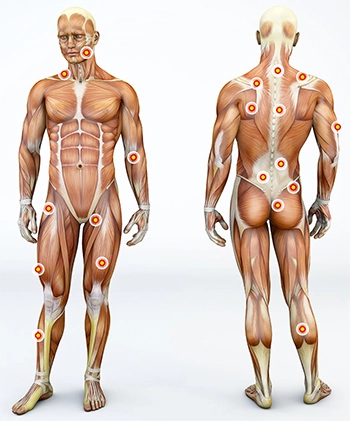
CAUSES OF MYOFASCIAL PAIN AND TRIGGER POINTS:
Accidents, falls, strain, and overuse are known causes of trigger point formation.
Fractures, dislocations and muscle tears resulting from past trauma, soft tissue trauma, and soft tissue or bone infections can cause trigger points to form. Injections into the gluteal muscle can sometimes cause a trigger point as well.
Excessive, unconscious, poor use of muscles can lead to trigger point formation. Occupational diseases, or a wallet constantly carried in the back pocket that presses on the gluteal muscle, can also be blamed.
Both a sedentary, exercise-free lifestyle and excessive sport can cause trigger points to form. Psychological state can sometimes cause trigger point formation as well.
 A depressed person constantly remaining in the same position has a negative effect on muscle metabolism, and a trigger point forms. I believe catatonic schizophrenia can be cited as an extreme example of this.
Looking at muscle metabolism from the perspective of trigger points, Vitamins B1, B6, B12, C, and folic acid are very important. Calcium, magnesium, potassium, and iron are also vital.
Deficiencies in these vitamins and minerals are seen particularly in the elderly, pregnant women, dieters, lower socioeconomic groups, and those with depression or serious illness.
Disruption of muscle metabolism due to chemical and hormonal causes leads to resistance in trigger point treatment. In addition, nicotine, caffeine, and alcohol are factors that reduce our success rate in treatment.
TREATMENT OF TRIGGER POINTS WITH NEURAL THERAPY
Once a trigger point is diagnosed and the muscle in which it is localized is identified, the procedure to be performed is detoxification within the trigger point using 1% or 0.5% lidocaine or procaine.
The approach in question here should take the form of neural therapy.
The segment to which the muscle belongs must always be included in the procedure, and stretching exercises should be applied to ensure the distribution of the drug within the muscle.
In patients where treatment fails, an interference field should be investigated.
Sometimes it is necessary to add ganglion blockade as well. Command of manual therapy is required to resolve highly resistant trigger points and the joint dysfunctions they cause.
The most effective form of therapy is Neural Therapy & Manual Therapy & Magnetic Field Therapy. While dry needling and acupuncture may provide temporary relief in this regard, they are truly unsuccessful in the treatment of active trigger points.
Sources Consulted:
• Nazlikul, H: Nöralterapi Ders Kitabı
• Nazlikul, H: Nöralterapi Başka Bir Tedavi Mümkün
• H. Barop's Nöralterapi Atlası (Translator: H. Nazlikul)
• L. Fischer's Nöralterapi Kitabı (Translators: H. Nazlikul and Y. Tamam)
• James W. NcNabb, Eklem ve Yumuşak Doku Enjeksiyonları (Translators: H. Nazlikul and Y. Tamam)
• Weinschenk, S: Neuraltherapie
• Fıscher, L et al: Lehrbuch Integrative Schmerztherapie