


How Is Neural Therapy Applied? What Exactly Does a Physician Practicing Neural Therapy Do? Neural…

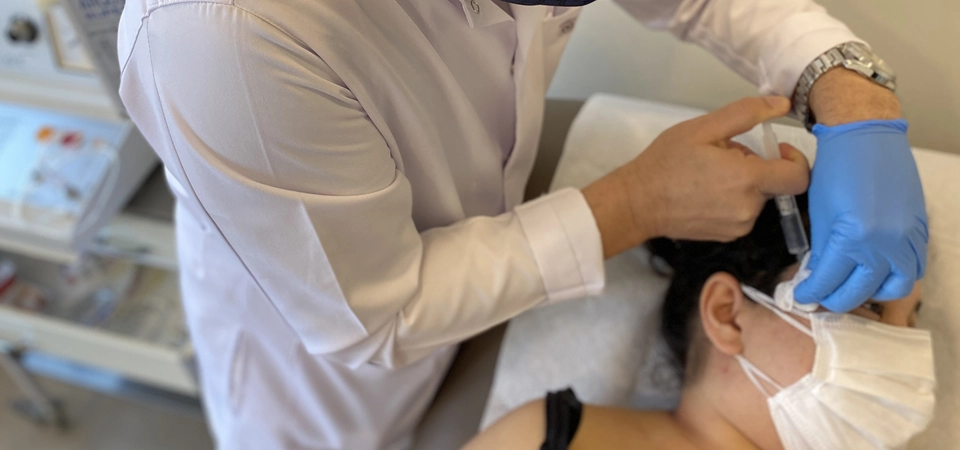
You should make sure that the physician you choose for neural therapy treatment holds an IFMANT & BNR diploma, because in Turkey, world-standard training in this field is provided solely by BNR (the Scientific Neural Therapy and Regulation Association) under the name IFMANT. The physician has several options for approaching the case in a therapeutic manner. First, they will have a long and comprehensive conversation with the patient about their medical history. This conversation is called the “anamnesis.” In this conversation, information about all the patient’s past illnesses, accidents, or surgeries is quite important. The temporal relationships of previous illnesses can point to an “interference field.” An example of this would be digestive problems that develop after a gallbladder operation.
In the initial basic examination, the physician applies various techniques. With these techniques, they locate what are called trigger points—pain and reflex regions—by hand. These are localized, limited muscle contractions that respond sensitively to pressure. Pain frequently radiates from these regions to other parts of the body. For example, “a trigger point in the neck or shoulder region” can cause a headache.
The physician then administers one or more injections of procaine or lidocaine directly under the skin at the site of the pain. This method is called the “quaddle—subcutaneous injection” method. A brief, short-lived welt (quaddle) is usually seen on the skin after the injection. This welt disappears within a few minutes. Through the injection, the body produces a response via the sensitive nerves in the skin and the distribution of the nerve network. This is called diagnostic (diagnosis-confirming) treatment.

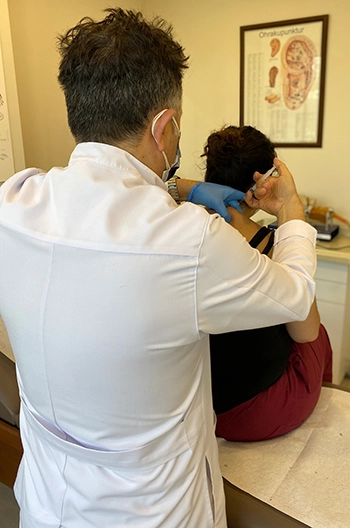 Sometimes the physician also administers injections to deeper parts of the body—commonly known as hardened muscle knots, nerve endings, or the points where a nerve exits the bone. Whether this is necessary depends entirely on the nature of the condition and the persistence of the pain.
In addition, a small amount of local anesthetic is also administered to affect blood circulation and the vegetative nervous system. In circulatory problems affecting arteries, injections made around and into the artery are successful. However, this technique is never applied to vessels leading to the brain. For joint pain, injections are generally made into the joint capsule at long intervals. If the suspected condition causing the patient’s symptoms suggests the presence of an interference field, the physician searches for clues like a detective looking for the culprit. In doing so, the physician’s knowledge and experience regarding the integrity (interconnection) of body parts and organs are of great help.
Here, it is particularly important to take into account the patient’s history and, if available, findings from previous illnesses. After the first treatment, pain and discomfort often appear in other parts of the body as well. While patients may feel anxious about this pain that was not present before, for neural therapists it is important data. For example, in a patient with lower back pain, if pain begins in a previously asymptomatic, chronically inflamed, and unnoticed tooth after segment therapy, this can suggest that the back pain originated from that tooth. In such cases, because pain that did not previously exist suddenly appears, this phenomenon—called the “retrograde phenomenon”—points to the presence of an “interference field.” In this case, the painful region must also be treated.
A brief, short-term increase in pain in the region being treated with neural therapy (which is usually around the lower back area) can indicate the presence of an interference field. The physician will search for this interference field in future treatments. In some cases, there may even be more than one interference field present at the same time. For the treatment to be successful, the physician must find and treat these interference fields.
As a rule, an injection made to the region thought to be the source of the stimuli—for example, “the tonsils or an old scar”—shows an immediate effect. If the pain disappears suddenly and permanently after the injection, the interference field has been eliminated and healed. This event is called the “seconds phenomenon.”
Sources Used:
• Nazlikul, H: Neural Therapy Textbook
• Nazlikul, H: Neural Therapy, Another Treatment Is Possible
• H. Barop’s Atlas of Neural Therapy (Translator: H. Nazlikul)
• L. Fischer’s Neural Therapy Book (Translators: H. Nazlikul and Y. Tamam)
• James W. NcNabb (Translators: H. Nazlikul and Y. Tamam), Joint and Soft Tissue Injections
• Weinschenk, S: Neuraltherapie
• Fıscher, L et al: Lehrbuch Integrative Schmerztherapie