


The core principle behind the neural therapy approach: Being healthy is a right The human being is…

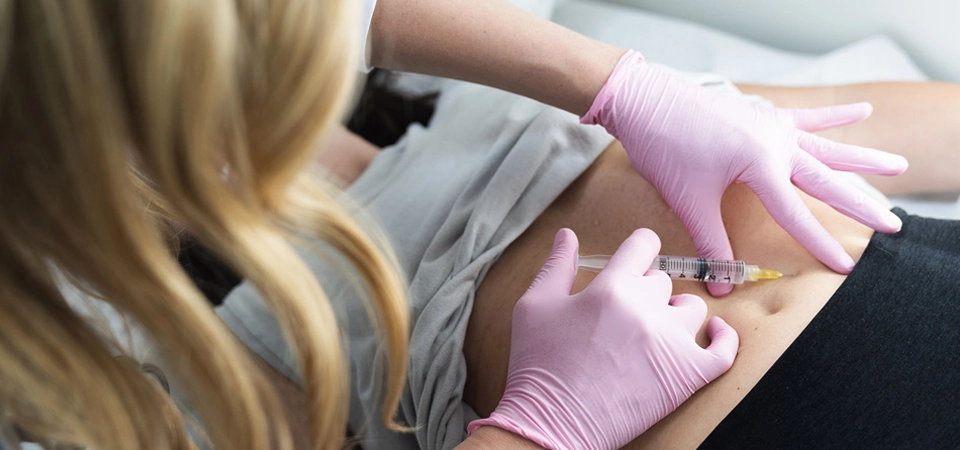
The human being is not a machine. Repairing parts or replacing them with new ones does not make the whole body healthy. Treatments aimed solely at repairing a disease whose symptoms are visible in the body—or, put another way, at repairing damaged organs and tissues—are not successful on their own.
To make a person healthy, it is necessary to understand that the body, mind, and spirit form a whole and interact with one another.
If treatment is approached within this wholeness, a person can regain their health. In Neural Therapy and Regulation Medicine, we evaluate health and illness as a whole, and we approach problems on this basis.
WHAT IS NEURAL THERAPY?
To understand how this treatment works, the first thing we must do is take a close look at some of the processes within our bodies.
Our body exists through the excellent organization of extraordinarily complex systems working on top of one another, operating within certain rules and cycles. Some of these systems are the circulatory system, the digestive system, the hormonal system, the immune system, and metabolic regulation. All of these systems function flawlessly because they are managed extremely well and because the cells are in constant communication with one another.
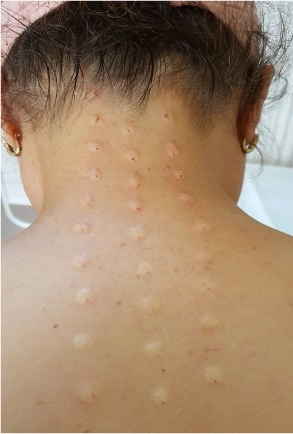 At the same time, the nervous system, which wraps around every part of our body like a network, plays an important role in this flawless functioning. When an illness arises, it does not affect just one or a few organs, such as “the gallbladder, the stomach, a joint.” On the contrary, it affects the entire system (the body). It is the task of medicine to intervene in this situation and bring the organism's processes, which have drifted away from their normal operating order, back into balance.
In the neural therapy approach, the body is not viewed as an organism made up of the sum of individual organs. Because in the wholeness and regulation approach, alongside each organ working without problems, the relationships between organs, the body's energy, and the person's psychological and social state are also important. For this reason, at the foundation of this approach, the connective tissue that forms the central axis and the true functionality of the Autonomic Nervous System, which regulates all of the body's functions, are evaluated as a whole, and diagnosis and treatment are carried out on this basis.
Neural therapy is a modern treatment method used to regulate the organism as a whole. For this reason, neural therapy does not consider only certain symptoms. On the contrary, it observes the body's entire “operating system.”
The prerequisite for success in treatment is an accurate diagnosis!
- What are the complaints?
- Which function do these complaints impair?
- Where did the functional disorder begin?
TO FIND ANSWERS TO THESE QUESTIONS IN NEURAL THERAPY:
In the neural therapy approach, it is necessary to listen to the patient very carefully, establish the temporal relationship well, and take a thorough medical history.
Patients generally describe their complaints according to their emotional experience—as terrifying, dreadful, distressing, and unbearable. Patients may feel fearful, anxious, troubled, and unable to bear the pain any longer because of their discomfort. Secondly, it is necessary to precisely describe the pain itself—whether it is dull, faint, stabbing like a knife, migratory, cutting, or constricting.
If a loss of function, such as ‘‘I can't comb my hair because my shoulder hurts so much,’’ is the more prominent complaint, it means the patient cannot tolerate the underlying loss of function more than the pain itself.
The functional disorders in the body caused by the illness are perceived as threatening and dangerous.
To achieve good results in regulation therapy, alongside the primary symptoms, it is essential to evaluate seemingly minor symptoms that may be the cause or trigger of the regulatory disorder affecting the entire system.
In this context, the medical history reveals the importance of overlooked, unnoticed, and ongoing inflammations that may serve as an interference field or interference focus, laying the groundwork for a potential ailment. These fields or foci can cause distant symptoms in remote areas of the body, or they can affect the area where they are located.
THE PATIENT PERSPECTIVE IN NEURAL THERAPY
In line with the saying “the patient examination begins the moment the patient walks through the door,” the patient's posture, movements, and general self-expression are important in the functional analysis. The better this analysis is, the greater the success of the treatment will be.
Palpation
Palpation and Kibler's skin-rolling technique, deep palpation, and the assessment of the musculoskeletal system's function are the most important methods for diagnosis and treatment monitoring.
Palpation techniques
In addition to evaluating the function of the musculoskeletal system, palpation is an important diagnostic method for identifying reflex (referred) conditions.
Superficial palpation
Superficial palpation provides information both about the skin's ability to glide over the layer beneath it and about skin turgor, as well as connective tissue turgor. Changes in pressure detected beneath the palpated skin provide information about areas where functional loss is present.
Kibler's Skin-Rolling Test
The skin is rolled between the thumb and index finger of both hands. As the skin is rolled between the two fingers in the caudo-cranial direction, in an area of disturbed function the skin over the reflex zone changes in character, loses its smoothness, or catches at that level.
Deep, graduated palpation
Deep tissues, such as myofascial changes, can only be detected and delineated through circular movements made with the pad of the finger.
This type of palpation makes it possible, starting from the painful region, to trace back to the source of the disturbance and identify the areas requiring intervention.
Identifying Trigger Points in Neural Therapy
Pressure applied to maximal points reveals pseudoradicular pain—pain that spreads along the kinetic chain producing the symptom.
Trigger point infiltration is, in practice, an intervention on the referred-pain symptom of the strained kinetic chain.
Interference field therapy and spinal therapy generally need to be added as well. Here, all active trigger points must be treated; otherwise, any trigger points left untreated can cause the condition to flare up again.
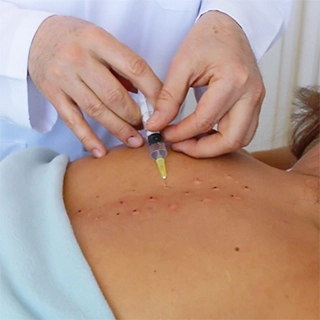 NEURAL THERAPY APPLICATIONS ARE PERFORMED BY INJECTING LOCAL ANESTHETIC
There are two main local anesthetic products used in neural therapy: procaine and lidocaine.
Procaine is the product we prefer most in neural therapy applications. In addition to procaine's short-acting local anesthetic effect, its metabolites, para-aminobenzoic acid (PABA) and diethylaminoethanol (DEAE), also have beneficial effects on the body.
This property of procaine makes it possible to achieve more than one effect with a single drug, which is why it has been used clinically for a variety of purposes for nearly a century.
In addition to its antihistaminic effect, PABA is a building block of folic acid, and one of its important roles is protecting the vascular endothelium by binding ceramide, which is active in cell necrosis.
However, local anesthetics also have other beneficial properties, such as regulating bronchial activity, and having anti-inflammatory, antibacterial, antifungal, analgesic (for both acute and chronic pain), antitumor, neuroprotective, antithrombotic, antiepileptic, antiarrhythmic (in ventricular arrhythmias), and vasodilatory (except for procaine) effects.
Because of these effects, the use of local anesthetics for various purposes has increased in recent years, both in treatment and in preventive medicine—in disease prevention, strengthening the immune system, and anti-aging effects.
WHO CAN RECEIVE NEURAL THERAPY?
- Neural therapy can be applied to patients of any age, including children and the elderly.
- Conditions such as high blood pressure, diabetes, heart disease, and the medications the patient is using are not obstacles to treatment.
- Only in patients using cortisone is the treatment's effectiveness reduced, since the body's immune response is suppressed altogether.
- Caution should be exercised with certain applications in patients using the blood thinner coumadin. Applications made to the skin are generally free of any risk.
WHAT CONDITIONS DO WE TREAT WITH NEURAL THERAPY?
- Pain treatment
- Headache
- Tension-type headache
- Cluster headache
 Migraine
- Toothache
- Shoulder pain
- Shoulder dysfunction
- Knee pain
- Neck pain
- Cervical disc herniation
- Lower back pain
- Lumbar disc herniation,
- Back pain
- Facial paralysis
- Dizziness
- Forgetfulness
- Tinnitus
- Detox
- Allergy treatments
- Sinusitis
- Chronic tonsillitis
- Organ function disorders
- Circulatory disorders
- Hormonal disorders
- Joint and extremity swelling
- Sports injuries
- Chronic constipation, hemorrhoids
- Neuralgia, facial paralysis, and other forms of paralysis
- Interference fields
- Interference focus
- Anti-aging
- Treatment of postpartum conditions…
Sources Consulted:
• Nazlikul, H: Nöralterapi Ders Kitabı
• Nazlikul, H: Nöralterapi Başka Bir Tedavi Mümkün
• H. Barop's Nöralterapi Atlası (Translator: H. Nazlikul)
• L. Fischer's Nöralterapi Kitabı (Translators: H. Nazlikul and Y. Tamam)
• James W. NcNabb, Eklem ve Yumuşak Doku Enjeksiyonları (Translators: H. Nazlikul and Y. Tamam)
• Weinschenk, S: Neuraltherapie
• Fıscher, L et al: Lehrbuch Integrative Schmerztherapie