


Types of Treatment in Neural Therapy Neural Therapy - Local / Superficial Treatment, Segmental and…

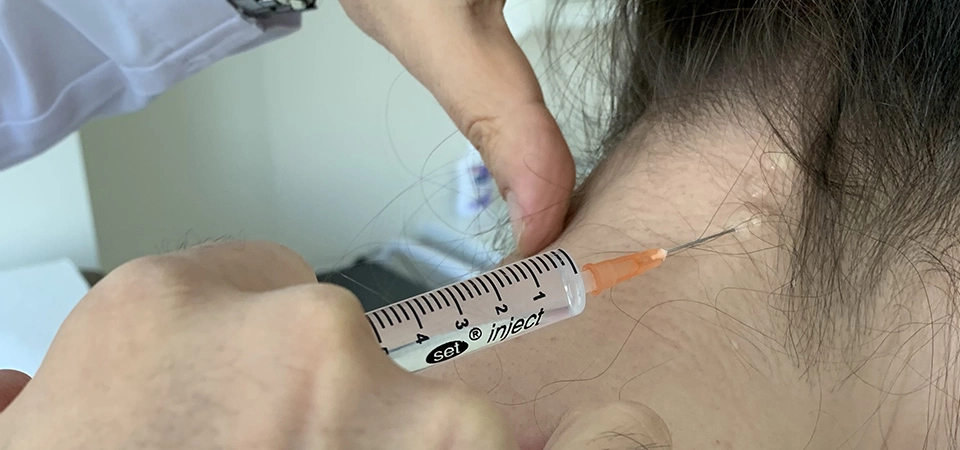
1- Local / Superficial Treatment
The first approach is local, that is, regional treatment. A subcutaneous injection called a "quaddle" is made wherever the pain or problematic organ is located locally.
With the superficial injection method, sensitive points, the perivascular sympathetic plexus, and sympathetic and parasympathetic nerve fibers are treated. These are specific structures in the body that can convert the local anesthetic signal at the needle tip into an action potential.
Studies have shown that these structures, defined as acupuncture points, are locations where autonomic (vegetative) nervous system fibers are found in high concentration, particularly around blood and lymphatic vessels (Research: Schnorrenberger, Germany). Treatment of these vegetative points—defined as acu-points and found on the body, the ear, the scalp, inside the mouth, on the tongue, and in other regions—is very important for the regulation of the autonomic nervous system. Its advantage over traditional Chinese acupuncture treatment is that injecting appropriate medications into these vegetative points produces a dramatically healing effect.
2- Segmental and Deep Injections
Segmental treatment is applied in cases where local treatment is ineffective. The definition of a segment is not the same as a dermatome; a segment encompasses the dermatome. The essence of segmental treatment is that any stimulus (irritation) causes a reflex response in all or part of the segment, and an interaction occurs from the periphery to the organ and from the organ to the periphery via a pathway through the spinal cord (the cutaneo-visceral reflex arc). A very simple example of this: a patient has neck pain, but no problem is found on examination—the issue may originate not from the neck but from the diaphragm, heart, lungs, gallbladder, or thyroid. In other words, what we call a segment is an extremely comprehensive and complex system that requires neural therapists familiar with it to correlate the patient's responses.
3- Ganglion Treatment
In cases where no response to treatment is obtained, it becomes necessary to intervene with the organs exerting a higher-level effect. In this sense, the nerve junction (ganglion) or trigger points located in the affected region are also stimulated and included in the treatment. Autonomic ganglia can become toxic and remain in that state for a long time. Performing a ganglion injection is the fastest way to achieve ganglion detoxification. By "ganglion injection" we do not mean direct injections into the ganglion itself, but local anesthetic infiltrations made around the ganglion.
4- Treatment of Latent Acidosis
Rather than focusing on the disease of a single organ, our approach is aimed at regulating the whole. Treatments directed at organs and tissues with chronic disorders and degeneration may reduce the patient's complaints, but they do not resolve the problem at its root. Underlying this lack of resolution is the toxic load accumulated in the connective tissue, in other words, latent acidosis (hidden acid load). For this reason, the effectiveness of treatments can only be seen after long-term observation. From this perspective, it is not really possible to restore the health of people with chronic disease without properly regulating the neurovegetative nervous system and cleansing the connective tissue. This may also require research and the use of different treatment methods (including, when necessary, conventional medical knowledge and procedures). Neural therapy is indispensable for succeeding in this cleansing process.
Sources I Have Drawn On:
• Nazlikul, H: Neural Therapy Textbook
• Nazlikul, H: Neural Therapy, Another Treatment Is Possible
• H. Barop's Atlas of Neural Therapy (Translator: H. Nazlikul)
• L. Fischer's Neural Therapy Book (Translators: H. Nazlikul and Y. Tamam)
• James W. McNabb, Joint and Soft Tissue Injections (Translators: H. Nazlikul and Y. Tamam)
• Weinschenk, S: Neuraltherapie
• Fischer, L et al.: Lehrbuch Integrative Schmerztherapie