


Misconceptions About the Harms and Side Effects of Neural Therapy Every medical intervention has a…

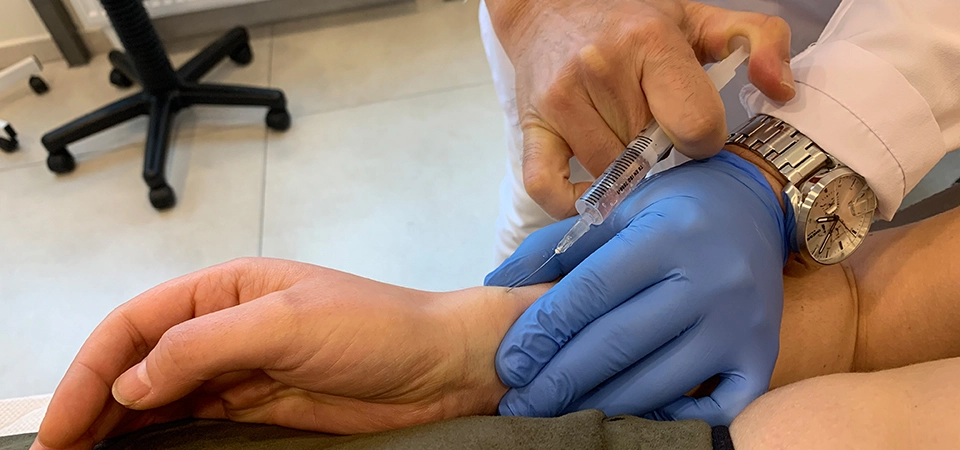
Every medical intervention has a side effect. Every injection—even something as simple as drawing blood—has side effects such as pain or bleeding from the needle prick. Neural therapy, a natural treatment (regulation medicine) method that has been applied thousands of times worldwide for a century, has very few side effects.
As a rule, very short-acting local anesthetic substances such as procaine or lidocaine are used (the half-life of procaine is 15-30 minutes, and that of lidocaine is 1-1.5 hours). Side effects depend on the injection technique, the local anesthetic used, individual sensitivity, or other medications being taken (coumadin, Plavix, etc).
What is a Local Anesthetic?
Agents that, upon contact with nerve fibers at an appropriate concentration, reversibly block impulse conduction in those fibers are called local anesthetics.
TO AVOID HARM AND SIDE EFFECTS WITH NEURAL THERAPY, YOU MUST CHOOSE THE RIGHT PHYSICIAN!
Neural therapy has no harm or side effects whatsoever when applied correctly by trained physicians.
Neural therapy is an interventional regulation medicine application. The physician performing these injections must be properly trained.
Neural therapy can be safely applied by a physician who has received training both in injection techniques and in the medications used.
You can access the list of all physicians in Turkey who have completed their training in neural therapy and are specialists and instructors on the website of the Scientific Neural Therapy and Regulation Association at www.noralterapi.com.
For neural therapy applications, I recommend consulting a physician whose name appears on the Scientific Neural Therapy Regulation Association's list. Neural therapy training lasts two years and carries international validity.
You can find the list of internationally recognized associations and institutions at www.ifmant.com.
IFMANT is the short name for the International Federation of Medical Associations for Neural Therapy. It is the top institution, affiliated with the World Health Organization, that determines the training curriculum for preventive medicine and regulation. In this sense, neural therapy training is a subspecialty beyond standard medical specialization. The only institution in Turkey with international validity that provides this training is BNR (Scientific Neural Therapy Regulation Association). For this reason, it is important for your health that the physician who will perform neural therapy on you holds a BNR or IFMANT diploma.
DOES NEURAL THERAPY HAVE SIDE EFFECTS?
Patients considering neural therapy may have questions in mind such as "What's in these injections?" "What are the side effects and harms of the injection?" "Will the injection hurt a lot?" and "Could this injection harm my organs or nerves?"
Neural therapy was unknown in Turkey before 2003. Neural therapy was introduced to Turkey by me (Hüseyin Nazlikul).
We have provided, and continue to provide, training through the Scientific Neural Therapy Regulation (BNR) Association, which was founded in 2004 under my presidency. Thanks to the training provided by our association, neural therapy has become well known in Turkey. Since the day we gave our first trainings, we have referenced an internationally valid training curriculum, initially providing training within the framework of the IGNH www.ignh.de curriculum.
Since 2010, we have been providing training within the framework of the IFMANT Federation's curriculum. The training we provide at BNR is recognized in 32 countries. Neural therapy has been a widely applied treatment method in Western countries, particularly Germany, since 1905. When performed by trained physicians, these applications have no known side effects.
-
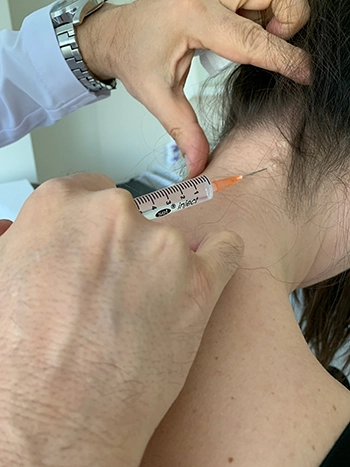 Because neural therapy is a regulation treatment, it is considered a natural treatment.
 -
Some people may be allergic to local anesthetic substances. Before neural therapy applications, the patient is asked whether they have any allergies and is tested.
-
In the neural therapy applications I have performed successfully since 1994, I have not encountered a single allergic reaction to procaine.
-
In the neural therapy method, benefit is drawn from the positive stimulation that short-acting local anesthetics such as procaine or lidocaine have on the autonomic nervous system.
-
Bleeding may occur at the injection site during neural therapy application.
-
Some sensitive patients may experience vasovagal syncope, meaning they may faint. However, this syncope is not specific to neural therapy and can be seen during any type of interventional procedure.
-
As soon as neural therapy injections are made into the skin, muscles, tendons, around blood vessels, into peripheral vessels, joints, ligaments, nerve conduction sites and around ganglia, this stimulus spreads through the nerve network, and old nerve damage is bio-electrically corrected.
-
Not every injection or needle treatment is neural therapy.
-
In classic injections, cortisone and various other substances are applied.
-
In neural therapy applications, only procaine or lidocaine is used, without being enriched with any other medication.
-
In neural therapy, unlike mesotherapy applications, different substances are not mixed together. This is because there is no reliable research on the effects of the new chemical substance that would form when these medications are combined.
-
In neural therapy, the local anesthetic effect of the medications is not the goal; on the contrary, the main purpose is to benefit from their bio-electrical effects.
-
The local anesthetic we use, procaine, is a highly beneficial substance. Procaine is a local anesthetic with few side effects, a short half-life, low toxicity; it is sympatholytic (halts negative stimuli on the sympathetic nervous system), causes vascular dilation (increases tissue blood supply), is bronchospasmolytic (halts and even reverses spasm occurring in the bronchi of the lungs), increases coronary perfusion, is negatively inotropic and anti-arrhythmic, anti-inflammatory (halts and treats inflammation), analgesic, antibacterial, antiviral, anticancerous, neuroprotective, and antithrombolytic.
-
Procaine is the shortest-acting local anesthetic. Its duration of effect is 15-20 minutes. It is a natural substance derived from nettle and bitter almond.
SIDE EFFECTS AND COMPLICATIONS OF NEURAL THERAPY
-
Those related to technique (depending on how the needle is used)
-
Those related to the local anesthetic
The most common side effect during local anesthetic application is
vasovagal syncope.
The most commonly observed side effect in clinical practice is a psychogenic reaction. It is generally observed in men under 35 years of age. Vasovagal syncope can cause a temporary loss of consciousness.
The causes of vasovagal syncope are the activation of vagal reflexes triggered in a person by fear, emotional stress and pain threshold.
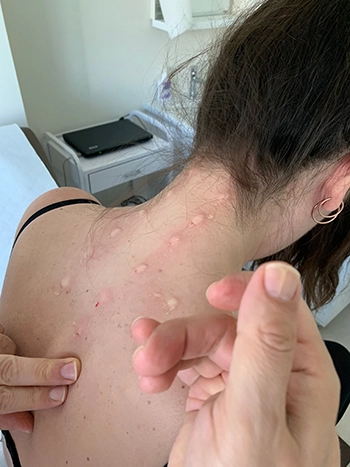 POSSIBLE SIDE EFFECTS DURING NEURAL THERAPY APPLICATIONS:
-
If there is contact with a nerve, a brief feeling of unease in the relevant nerve region, weakness in the relevant muscle, etc. may occur. This is a condition specific to the method itself and, as a rule, completely disappears within 15-60 minutes (depending on the local anesthetic substance used).
-
Very common: Small bruises, pain from the needle prick, and bleeding.
-
Common: Mild circulatory complaint, dizziness, numbness after the application.
-
Occasionally: Pain at the injection site that can last a few days.
-
Rarely: Hematoma at the injection site or bruising that can last a few days.
-
Very rarely: Allergic reaction to the local anesthetic used. Vascular or nerve injury (as a rule, this heals completely and quickly).
-
Extremely rarely: Bleeding or nerve damage resulting from injury to major blood vessels, internal organ injury (pleura, liver, kidney), anaphylactic shock (allergic shock), difficulty breathing, cramping.
SO WHO CAN RECEIVE THIS HIGHLY BENEFICIAL NEURAL THERAPY?
Most of the patients who come to us are people who have not benefited from conventional treatments. Neural therapy is a treatment method preferred largely by patients whose conditions have proven resistant to treatment and for whom modern medical methods and medications have not provided a solution. Neural therapy is always the first-choice treatment for patients who have been introduced to and have undergone these applications. Neural therapy is a treatment that can be applied to patients of any age group.
-
It can be applied to women during menstruation, to pregnant women, and to breastfeeding women.
-
Hypertension, diabetes, metabolic diseases, heart disease and medication use do not prevent treatment.
-
Deep injections are not given to patients using anticoagulant medications, known as blood thinners; caution should be exercised in superficial segment treatment applications to the skin.
-
Neural therapy is not applied to myasthenia gravis patients during attacks.
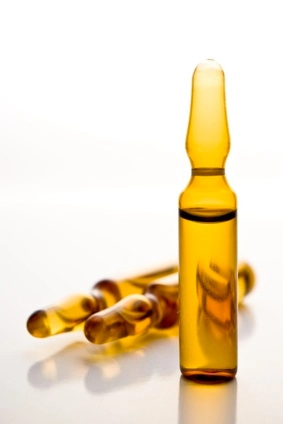 CHOICE OF LOCAL ANESTHETIC IN CLINICAL USE
-
The substance used should not cause an allergic reaction or local irritation
-
IV toxicity, cardiotoxicity, and central nervous system toxic effects should be minimal.
The Effects of Local Anesthetics from the Neural Therapy Perspective
-
Cell-protective effect (repolarization).
-
Detection and blocking of interference field stimuli that sustain the problem, and reorganization of disrupted communication.
-
Blocking the positive feedback mechanism caused by the interference field, allowing the underlying substance to rest and the disruptive stimulus to pause, independent of the duration of the local anesthetic's effect.
-
Alteration and correction of information flow in the connective tissue's proteoglycan matrix
-
Protection of the cell against external stimuli; reduction in the release of acidic metabolic products, ions, and pain-causing substances.
-
Blocking depolarization of sensory nerve endings.
-
Blocking conduction in sensory nerve fibers
-
Blocking pathological stimuli transmitted by the VNS through local anesthetic applications (IV, local, segmental, injection into the interference field), or re-regulating cells by stimulating them.
-
Since local anesthetic applications are performed via injection, this method benefits both from the stimulation caused by the needle itself (indirect effect) and from the local anesthetic's temporary blocking effect (direct effect).
Sources Used:
• Nazlikul, H: Nöralterapi Ders Kitabı
• Nazlikul, H: Nöralterapi Başka Bir Tedavi Mümkün
• H. Barop's Nöralterapi Atlası (Translated by H. Nazlikul)
• L. Fischer's Nöralterapi Kitabı (Translated by H. Nazlikul and Y. Tamam)
• James W. McNabb's Eklem ve Yumuşak Doku Enjeksiyonları (Translated by H. Nazlikul and Y. Tamam)
• Weinschenk, S: Neuraltherapie
• Fischer, L et: Lehrbuch Integrative Schmerztherapie