


How Is Myofascial Pain Syndrome (MPS) and Trigger Point (TP) Most Effectively Treated? Myofascial…

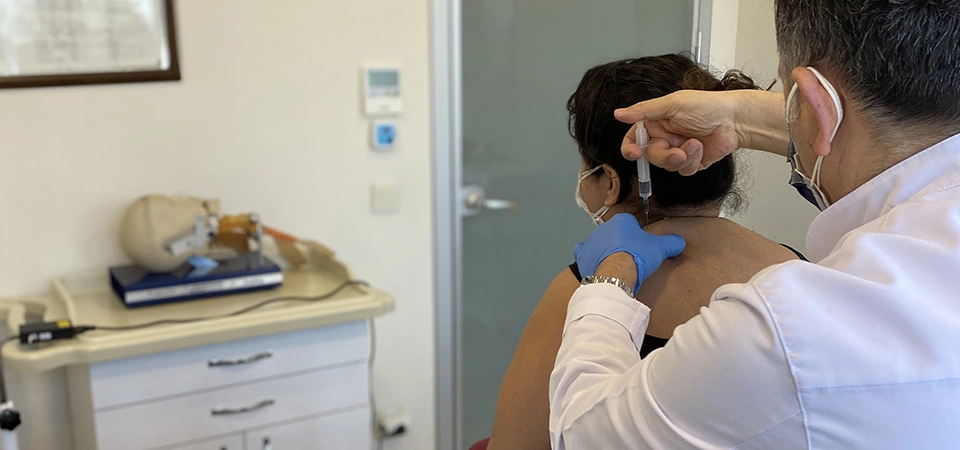
There are different treatment approaches for Myofascial Pain Syndrome (MPS) and Trigger Points (TP).
These are mainly as follows:
- Neural Therapy / Therapeutic Local Anesthesia (injection): Involves administering an injection of procaine or another local anesthetic into the trigger point. This injection numbs the pain fibers, relaxes the tension point, and is more effective than dry needling. It is the first-line approach for trigger point treatment.
- Single-Needle Acupuncture / Trigger Point Acupuncture (dry needling): In this method, an acupuncture needle is inserted into the TP and forcefully stimulated until the patient feels radiating pain. In most cases, the needle is removed immediately. Trigger point acupuncture can also be used in combination with traditional Chinese acupuncture.
- PIR - Stretching Therapy: In addition to trigger point treatment, stretching exercises generally help relax tense muscles. In some cases, TPs also appear in weak muscles. In this case, a combination of strengthening and stretching exercises is recommended.
- KinesioTape: This is a treatment done with certain elastic tape bandages that can help release a trigger point or stretch a muscle.
- Postural Correction: Faulty posture or load is often the cause of the trigger point. For this reason, postural disorders should be investigated and corrected (e.g., not always carrying a shoulder bag on the right side).
- Fascial Therapy: Relaxation of tension in tissues and muscles with manual (hands-on) techniques and aids.
- Manual Medicine - Physiotherapy / Manual Therapy: In complex or chronic disorders, supportive physiotherapy can help. This is particularly true for pelvic obliquity, scoliosis, and temporomandibular joint diseases.
MY PERSONAL EXPERIENCE: THE MOST EFFECTIVE COMBINATION IS NEURAL THERAPY + PIR.
TRIGGER POINT INJECTION NEURAL THERAPY APPLICATION
Neural therapy is a procedure that produces effects on the autonomic nervous system through the application of 0.5%-1% procaine or lidocaine to certain "disturbance fields and segmental areas." This generally leads to a reduction in pain. In addition to treating areas of dysfunction, primarily in the treatment of Myofascial Pain Syndrome (MPS) and Trigger Point (TP) treatment, the treatment of scars and segments is also important.
Neural therapy is a treatment that has an important effect on reducing pain with minimal risk.
Neural therapy is an integral part of the lasting solution to pain treatment.
The vegetative nervous system, otherwise known as the autonomic nervous system, participates in all vital organ activities and supports the body's own regulatory mechanisms. This effect is also used by neural therapy, a regulatory medical method applied by physicians with special diplomas from IFMANT, BNR, ÖNR, SANTH, and IGNH training programs.
Neural therapy is a treatment method encompassing holism and regulation. It essentially consists of injections of local anesthetic, usually containing procaine, into specific reflex points. It is generally applied to the area where dysfunction is identified, meaning it includes quaddles applied directly to the relevant trigger point, under the skin for the segment, and injections applied to the problematic ganglion, facet, or ligaments. In this way, positive effects can be applied to the underlying tissue or, through segmental reflex, to specific organs. In addition, there are also injection procedures applied directly to specific pain regions. In a facet block, infiltration with local anesthetic (LA) is provided for a short time to the small vertebra connecting two vertebrae, irrigating the problematic area with LA. If this is repeated, back pain decreases and the healing process speeds up. In addition, certain nerve roots, ganglia, and even plexuses are blocked for a short time with local anesthetics (LA). This is a reversible block. This is particularly true of the half-life of the local anesthetics (LA) used in the neural therapy approach — procaine and lidocaine.
The use of local anesthetics (LA) offers the physician an uncomplicated and low-risk method. It is effective and safe in reducing complaints within a few minutes. Infiltrations of muscles and pain points are performed. In addition, disturbance field treatment has significance beyond pain treatment for other functional disorders. Incidentally, this is a therapy method developed by general practitioners (according to Ferdinand and Walter Huneke, neural therapy, first published in 1928, was further developed in 1940). Today, IFMANT, IGNH, SANTH, ÖNR, and the Scientific Neural Therapy Association are responsible for advanced scientific studies and continuing education.
What is common to all these methods is that the injection is painful. Otherwise, there is no indication. The patient must be prepared for this. The rapid onset of effect quickly satisfies the patient. Short-acting local anesthetics such as procaine or lidocaine are used without additives and without cortisone.
STOPPING AND ERASING THE STIMULUS FROM THE PAIN POINT
Infiltration of pain points and pain regions in connective tissue or muscles is explained as follows: pain is seen at the origin of muscles, the collateral ligaments of the knee joint, the bursa, post-traumatic painful periosteal points, and myogeloses. Provided there are no problematic vessels or other structures in the area, the injection is applied "to where it hurts." This is why it is somewhat mockingly called "the treatment method of wherever it hurts."
MYOFASCIAL PAIN SYNDROME NEURAL THERAPY TECHNIQUE
TRIGGER POINT
The local anesthetic is applied primarily into an identified active or latent trigger point, with some also injected near tendons, ligaments, the periosteum, or other painful structures, or directly into painful muscles (entesopathies or myogeloses).
The Effect of LA
The following effects can be expected:
- Relieves pain and relaxes muscles.
- Blood circulation improves.
If the reduction in pain lasts longer than the immediate effect of the local anesthetic — that is, if pain reduction lasting more than two hours and until the next appointment is seen — the infiltration can be repeated. If no further progress is achieved, the indication should be reviewed or the relevant factors should be eliminated. For example, in the case of epicondylitis, tension in the cervicothoracic junction should be relaxed.
Procaine reversibly inhibits motor and autonomic nerve fibers, locally limiting and canceling their conduction. First the sensation of pain, then temperature perception (cold, heat), and finally the sensation of touch and pressure decrease (Nazlikul 2017).
In addition, procaine affects the heart's excitation conduction, has an antiarrhythmic effect, and reduces the tone of smooth muscles. It also has a weak parasympatholytic effect.
There are various neural therapeutic techniques:
- Segmental treatment: Quaddle treatment, infiltration of trigger points, joints, periosteum, structures of the spine
- Ganglion treatment: Infiltration of spinal ganglia, plexuses
- Disturbance field treatment: Injection into an area suspected of being affected by an interference field.
- Systemic applications: Intravenous injection, infusion, extravasal injection, injection into vegetative ganglia.
Dr. Hüseyin Nazlikul
President of the Manual Medicine Pain Regulation Association (MTAR)
President of the Scientific Neural Therapy Regulation Association
President of IFMANT
Sources Consulted:
• Nazlikul, H: Neural Therapy Textbook
• Nazlikul, H: Neural Therapy – Another Treatment Is Possible
• H. Barop’s Neural Therapy Atlas (Translator: H. Nazlikul)
• L. Fischer’s Neural Therapy Book (Translators: H. Nazlikul and Y. Tamam)
• James W. McNabb, Joint and Soft Tissue Injections (Translators: H. Nazlikul and Y. Tamam)
• Weinschenk, S: Neuraltherapie
• Fischer, L et al.: Lehrbuch Integrative Schmerztherapie